Performance Max Vs Smart Campaigns

Performance Max and Smart Campaigns offer different levels of advertising sophistication on Google’s platform. Performance Max provides extensive AI-driven optimization across multiple channels like YouTube, Display, and Search, with advanced targeting and creativeThe visual or textual elements of an advertisement designed to capture attention and drive user action. Effective creatives are tailored to the ad format and target audience# balancing aesthetic appeal with persuasive messaging. options requiring diverse assets. You’ll need a larger budget ($50-$100/day) and more creative assets, but you’ll get detailed analytics and better control. Smart Campaigns are ideal if you’re a small business owner wanting a simplified, hands-off approach with basic automation, fewer required assets, and smaller budgets. The campaign you choose depends on your marketing goals, budget, and desired level of involvement – let’s explore which option fits your needs. If you’re aiming for rapid growth and have the resources to match, Performance Max could be the better choice due to its scalability and robust AI capabilities. On the other hand, Smart Campaigns are perfect for those new to digital advertising or with limited resources, providing a straightforward way to get started. By applying strategic budget management tips, you can ensure your spending aligns with your advertising goals, maximizing ROI regardless of the campaign type you select.
Understanding Performance Max
Finally: A Google Ads Affiliate Marketing Course That Actually Works
19 advanced modules, done-for-you templates, and live campaign examples from a proven $7M affiliate. Perfect for beginners and advanced marketers alike.
Performance Max campaigns revolutionize digital advertising by unifying your marketing efforts across Google’s entire network. This advanced automation system lets you reach potential customers across YouTube, Display, Search, Discover, Gmail, and Maps – all from a single campaign setup.
The key automation differences from previous solutions lie in its sophisticated AI-driven approach to optimization and broader reach capabilities. The platform requires setting specific conversion goals and ROAS to function effectively. A minimum budget of $50-$100 per day is recommended for optimal campaign performance. Performance Max evolved from traditional AdWords to meet modern marketing demands.
You’ll find that Performance Max operates on a goal-based framework. Simply set your objectives, whether they’re focused on conversions or conversionThe completion of a desired action by a user# such as a purchase# sign-up# or download. Conversions are the ultimate goal of most marketing campaigns and serve as a key metric for measuring success. value, and provide the necessary inputs like audience signals and creative assets.
The system then uses machine learning to optimize your campaign in real-time, adjusting bids and placements to maximize results.
To get the most out of Performance Max, you’ll need to:
- Provide high-quality creative assets (text, images, videos)
- Set up accurate conversion trackingThe process of measuring and analyzing how many visitors to a website complete a desired action, such as making a purchase or signing up for a newsletter.
- Share relevant audience signals
- Allow 6-8 weeks for performance stabilization
Remember that while the platform offers extensive automation, you still maintain control through asset reporting and performance insights.
You can continuously refine your strategy by monitoring which creative elements drive the best results and adjusting your approach based on the platform’s diagnostic insights.
Smart Shopping Campaign Overview
Smart Shopping campaigns offer you a streamlined approach to running Google Ads with automated bidding and feed optimization across multiple networks.
You’ll find these campaigns require minimal setup and maintenance while using machine learning to optimize for conversions and ROAS targets automatically. These campaigns analyze real-time signals like time, browser, device, and location to influence bidding decisions. These campaigns also seamlessly integrate with platforms like WooCommerce and Shopify for enhanced functionality.
The platform’s automated features handle everything from ad placement to bid management, though you’ll have less direct control over campaign elements compared to traditional shopping campaigns.
Advertisers implementing Smart Shopping have seen a 20% higher conversion value without increasing their ad spend.
Campaign Features Overview
Through thorough automation and simplified management, Smart Shopping campaigns offer advertisers a streamlined approach to running product-based advertisements across Google’s networks.
When conducting a campaign comparison, you’ll find that Smart Shopping’s automated bidding system works to maximize your conversions while maintaining your target ROAS, requiring minimal manual intervention. The campaign allows creation of up to 100 smart ads for testing different variations.
You’ll benefit from multiple ad formats that display across Google’s entire network, including Search, Display, YouTube, and Gmail. The system automatically optimizes your ad placement using real-time signals like user queries, time of day, and device type.
The platform requires an active product feed in Google Merchant Center to function effectively.
Advertisers can expect 48% lower CPCs on Display network placements compared to standard Shopping ads.
While you won’t have access to negative keywords or manual bid adjustments, the AI-driven targeting compensates by using demographic information, location data, and user behavior to reach potential buyers.
Key features include:
- Integration with Google Merchant Center
- Dynamic product selection
- Automated audience targetingThe practice of tailoring marketing efforts to reach a specific group of consumers most likely to be interested in a product or service.
- Remarketing capabilities
- Performance tracking tools
While you’ll have less direct control over campaign management, you’ll gain efficiency through automated optimization and broader reach across Google’s platforms.
This makes Smart Shopping particularly valuable if you’re looking to maximize conversions while minimizing hands-on campaign management time.
Budget and Performance Structure
Within Smart Shopping campaigns, the budget and performance structure follows a streamlined yet somewhat rigid framework. Your budget management options are simplified, with Google recommending you run all products within a single campaign. The internal competition between product groups can impact your campaign’s auction participation.
The system’s product feed management is essential for optimal campaign performance. While this approach maximizes efficiency through machine learning, it does limit your control over specific product categories. Early tests have shown that advertisers can achieve 20% higher conversions while maintaining similar costs.
The system’s automated performance enhancement focuses on maximizing conversion value, typically requiring a 15-day learning period to achieve ideal results. You’ll find that the campaign automatically tests different creative combinations to identify the highest-performing ads.
However, you won’t have access to granular controls like:
- Negative keywordThis is the term or phrase that users utilize to search for anything on the internet. This can also be the term focused on by SEO experts to drive organic traffic to their website. targeting
- Regional location settings
- Ad scheduling preferences
- Device-specific targeting
When it comes to tracking performance, you’re limited to cross-network and search network data segments. While you can set ROAS or CPA targets to guide automated bidding, detailed attribution becomes challenging due to the combined nature of shopping, display, and remarketing efforts.
This structure works well if you prefer a hands-off approach, but you’ll need to accept less direct control over your campaign’s specific parameters.
Key Platform Differences
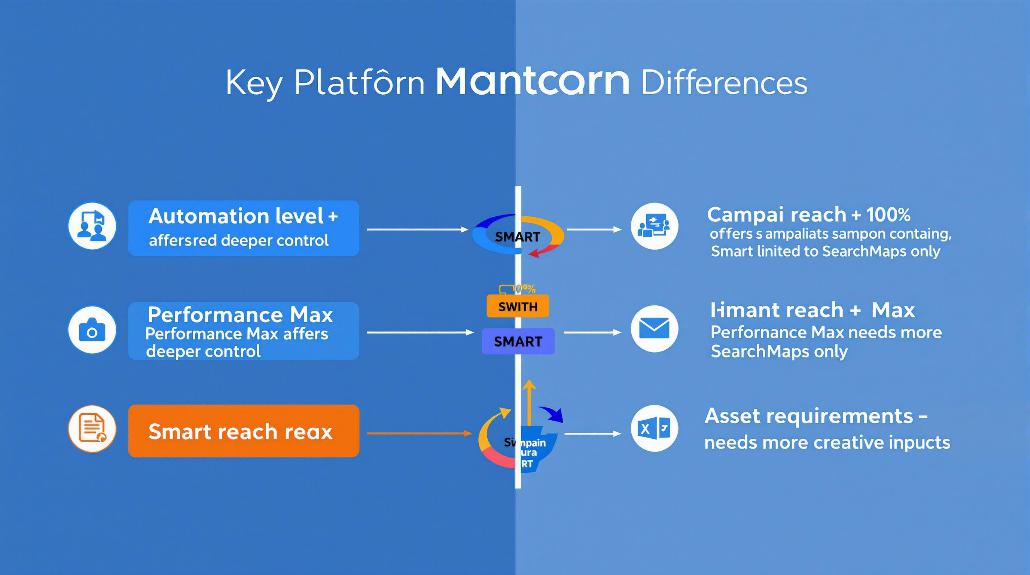
Performance Max and Smart campaigns exhibit fundamental differences in their capabilities, reach, and level of automation. When you’re comparing these platforms, you’ll notice that Performance Max offers notably broader reach across Google’s entire network, including Search, Display, YouTube, Gmail, and Discovery. This expanded coverage allows you to track performance metricsKey performance indicators used to measure the success of affiliate marketing efforts, such as conversion rate, EPC, and ROI. more thoroughly while maintaining a single campaign structure. The platform uses machine learning algorithms to optimize bidding strategies automatically. The transition in 2022 included an automatic upgrade process from Smart Shopping to Performance Max campaigns.
The key distinctions become apparent in three main areas:
- Ad Format Flexibility: Performance Max supports multiple formats including text, shopping, discovery, and display ads, while Smart campaigns are more limited.
- Targeting Options: You’ll get access to advanced audience targeting with Performance Max, including demographics, interests, and behavior-based signals. You can also leverage audience lists and customer data more effectively.
- Campaign Management: While you’ll have less direct control over specific placements, Performance Max’s AI-driven approach optimizes your campaigns across networks automatically. The platform offers detailed performance insights, though you won’t see channel-specific breakdowns like you might expect.
The unified budget management in Performance Max helps you maximize results by allowing the system to allocate spending across different inventories based on performance potential.
Campaign Reach and Coverage
Diving into campaign reach and coverage reveals stark differences between these two advertising solutions. While Smart Campaigns limited your presence to Google Search and Display Network, Performance Max dramatically expands your advertising footprint across Google’s entire ecosystem.
You’ll reach potential customers through Search, Display, YouTube, Gmail, Maps, and Discovery – all from a single campaign.
Here’s what makes Performance Max’s campaign reach superior:
- Access to all of Google’s advertising inventory, including text, shopping, display, and video formats
- Cross-channel consistency that maintains your brand message across all platforms
- AI-powered optimization that automatically adjusts your presence across networks
- Advanced audience targeting based on demographics, interests, and behaviors
- Real-time data analysis that continuously improves ad delivery and performance
With Performance Max, you’re not just getting wider coverage – you’re getting smarter coverage.
The platform’s sophisticated targeting capabilities let you define specific audiences while maintaining the flexibility to reach them wherever they are.
This all-encompassing approach to campaign reach guarantees your ads appear in the right places, at the right times, to the right people, making your advertising budget work harder and more efficiently. This strategy not only optimizes ad placement but also ensures your message resonates with your target audience, driving higher engagement and conversions. By implementing actionable Google Ads tips 2024, you can refine your targeting, improve ad copy performance, and leverage advanced tools to stay ahead in a competitive landscape. Ultimately, this empowers your brand to maximize ROIReturn on Investment, a key performance indicator calculated as a percentage by dividing profit by cost and multiplying by 100. while consistently adapting to industry trends and consumer behavior.
Targeting and Audience Options
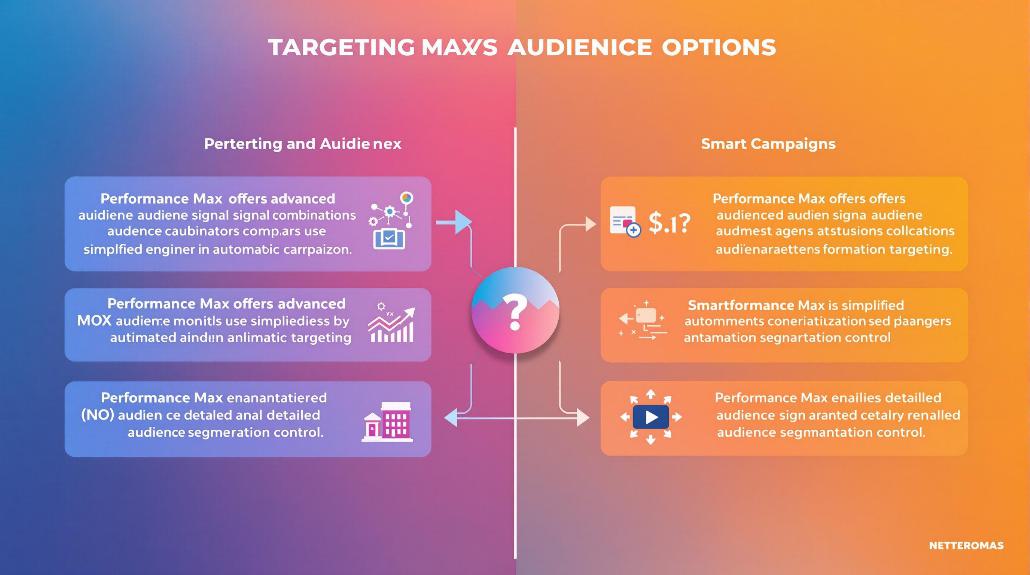
When you’re comparing Performance Max and Smart campaigns, you’ll notice a significant difference in targeting capabilities that gives Performance Max a clear advantage.
Performance Max lets you tap into advanced audience features like custom segments, remarketing lists, and detailed demographic targeting that weren’t available in Smart campaigns.
You can also fine-tune your location targeting with Performance Max, choosing between “Presence” or “Presence or interest” options to guarantee your ads reach the right people in the right places.
Advanced Targeting Features
Understanding targeting capabilities reveals stark differences between Performance Max and Smart Campaigns in how they approach audience engagement.
Performance Max offers advanced targeting capabilities through sophisticated machine learning and diverse data signals, while Smart Campaigns provide basic automated targeting with limited customization options.
With Performance Max, you’ll gain access to:
- Real-time audience insights that leverage first-party customer data
- Cross-platform optimization using AI-powered algorithms
- Multiple ad formats including text, images, and video assets
- Custom audience signals based on user behavior and interactions
- Detailed targeting parameters for demographics and interests
Performance Max empowers you to enhance your targeting strategy using robust data from desktop and mobile visitors, page views, and past converters.
You can create highly personalized ad experiences across Google’s entire network, with the platform’s AI continuously optimizing for better performance.
In contrast, Smart Campaigns operate with simplified targeting focused primarily on Google Search and Display networks, offering basic demographic options and keyword themes.
While Smart Campaigns excel in simplicity, they limit your ability to leverage advanced audience targeting features that could drive better campaign results.
Location-Based Audience Controls
Location-based audience controls represent a major differentiator between Performance Max and Smart campaigns, particularly in how each platform handles geographic targeting and audience segmentation.
While both campaign types offer location targeting capabilities, Performance Max provides more sophisticated options for reaching specific geographic areas and audiences within those locations.
With Performance Max, you’ll get access to enhanced location targeting features that let you:
- Target multiple locations simultaneously
- Exclude specific geographic areas
- Adjust bid modifiers based on location performance
- Layer audience signals with location data
The platform’s integration across Google’s entire network means you can reach potential customers wherever they are, whether they’re searching on Google Maps, watching YouTube videos, or checking Gmail.
You’ll also benefit from automation insights that help you understand how your location-based targeting strategies are performing and where there’s room for improvement.
Unlike Smart campaigns’ more limited geographic options, Performance Max’s location-based controls work in conjunction with its broader reach and advanced audience signals, giving you more precise control over who sees your ads in specific areas.
Budget Control and Spending
Comparing budget control between Performance Max and Smart campaigns reveals fundamental differences in approach and capability.
While Smart campaigns offer straightforward budget management for local advertising, Performance Max provides enhanced budget allocation flexibility across multiple channels and objectives. You’ll find that Performance Max’s AI-driven approach automatically optimizes your spending across Google’s entire network, making it easier to achieve your marketing goals.
- Performance Max combines budgets across inventories and channels, maximizing overall campaign effectiveness
- Smart Campaigns work best with smaller budgets and single-objective local advertising
- Real-time optimization adjusts your budget automatically based on performance data
- Detailed reporting helps you track and understand where your budget is most effective
- Integration with Google Analytics provides deeper insights into budget performance
To make the most of your Performance Max campaigns, you’ll need to monitor spending patterns and adjust your strategy based on performance metrics.
The platform’s sophisticated automation handles the heavy lifting of budget optimization, but you should regularly review the detailed insights provided to verify your spending aligns with your business objectives.
This data-driven approach helps you maintain control while leveraging the benefits of automated budget management.
Creative Asset Requirements
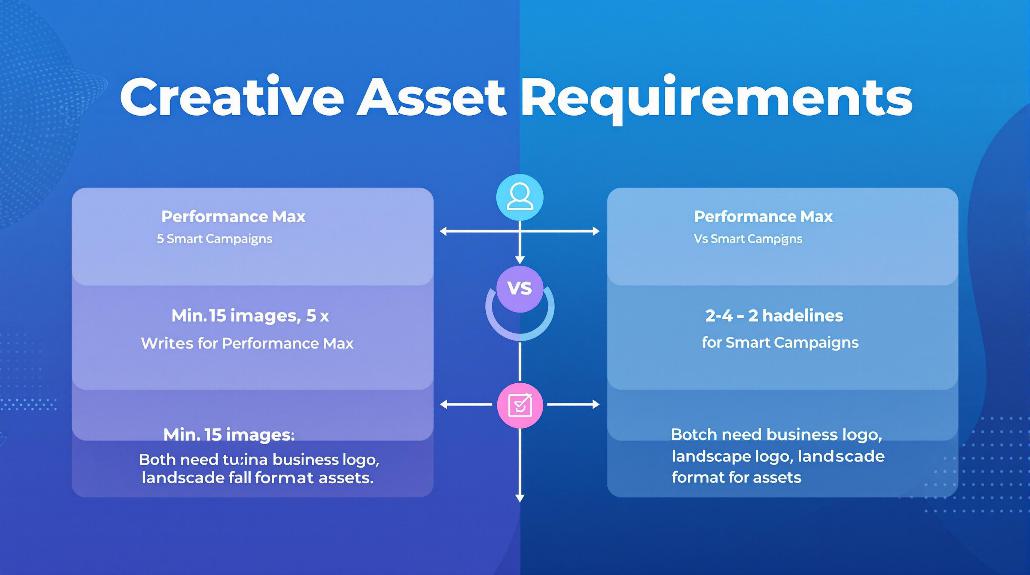
When you’re setting up a Performance Max campaign, you’ll need to provide a much wider variety of creative assets compared to Smart campaigns, including images, videos, logos, and multiple text variations.
Performance Max’s asset requirements are more extensive because they’re designed to give Google’s AI system the flexibility to create optimized ads across its entire network, from Search to YouTube to Display.
You’ll want to focus on delivering high-quality assets in each format since your campaign’s success largely depends on having enough creative elements for Google to test and optimize effectively.
Asset Types Needed
Smart Campaigns maintain straightforward creative asset requirements that make them accessible for businesses new to digital advertising.
You’ll need to provide both landscape and square images that meet specific size requirements, along with compelling text elements for your headlines and descriptions.
The essential assets you’ll need include:
- At least one landscape image (1.91:1 ratio, minimum 600 x 314 pixels)
- One square image (minimum 300 x 300 pixels)
- Multiple headlines and descriptions
- Square logos (optional but recommended, 128 x 128 minimum)
- Video content up to 30 seconds (optional)
You can upload up to 15 images and 5 logos in compatible formats like .jpg and .png, with file sizes under 1MB for standard campaigns or 5MB for Smart Display campaigns.
While you only need two images to get started, it’s recommended to provide multiple creative assets so Google can test different combinations and optimize performance.
Remember that all your images should be high-quality and relevant to your business, as they’ll appear across various placements in Google’s advertising network.
Performance Max Requirements
Performance Max campaigns demand a more thorough set of creative assets than their Smart Campaign counterparts. To meet performance benchmarks and maximize your campaign’s potential, you’ll need to provide multiple asset types that work together across Google’s advertising network.
For each asset group, you’ll need to include:
- Headlines: 3-15 variations (30 characters each)
- Long Headlines: 1-5 options (90 characters each)
- Descriptions: 2-5 variations (90 characters each)
- Images in multiple formats:
- Landscape (1.91:1 ratio)
- Square (1:1 ratio)
- Logo (1:1 ratio)
- Videos: At least 10 seconds long in various orientations
Your asset groups should be organized around specific themes or audience segments. If you’re running retail campaigns linked to Google Merchant Center, you’ll benefit from automatic asset generation.
For non-retail campaigns, you’ll need to upload your own creative assets that meet these specifications. While these requirements might seem extensive, they guarantee your ads can appear effectively across all of Google’s advertising channels, from Search to YouTube to Discovery.
Creative Format Differences
Between Smart Campaigns and Performance Max, the creative asset requirements differ considerably in both scope and complexity.
When you’re working with Smart Campaigns, you’ll need to follow specific guidelines that provide a balanced level of creative control while maintaining Google’s standardized format. You’ll need to supply at least two images – one landscape and one square – along with up to five headlines and descriptions.
Here are the key creative requirements for Smart Campaigns:
- At least 2 images with specific ratios: landscape (1.91:1) and square (1:1), with minimum sizes of 600×314 and 300×300 pixels respectively
- Up to 5 short headlines limited to 25 characters each
- Maximum of 5 descriptions with 70 characters each
- Between 1-5 logos in square format up to 1200×1200 pixels
- Optional video content for certain ad formats
To optimize your Smart Campaign performance, you’ll want to focus on asset variety rather than creating multiple ads with limited assets.
It’s recommended to update your creative assets every two weeks, swapping out underperforming elements while maintaining your brand standards.
Remember that Google automatically selects the call-to-action that’s most likely to drive results for your campaign.
Automated Optimization Features
Through advanced automation, both campaign types leverage sophisticated AI-driven features to optimize performance, though Performance Max offers considerably more robust capabilities.
You’ll find that Performance Max’s automated optimization features include real-time data analytics, dynamic bidding adjustments, and AI-powered asset creation that continuously refines your campaign’s effectiveness.
With Performance Max, you’re getting access to more sophisticated automated bidding strategies, including Target CPA and Target ROAS, which help you achieve specific performance goals.
The platform’s AI system analyzes signals across multiple channels to make instant optimization decisions that improve your campaign’s performance.
Key automated features include:
- Real-time performance tracking across all channels
- Dynamic ad creationThe process of designing and producing advertisements for various marketing channels. based on your asset library
- Automated landing page selection through URL expansion
- AI-driven audience targeting refinement
- Continuous bid optimization based on conversion likelihood
You’ll also benefit from the platform’s generative AI capabilities, which can create new ad variations and test different combinations automatically.
The system provides optimization scores and recommendations, helping you make data-driven decisions about budget allocation and campaign improvements.
Campaign Performance Metrics
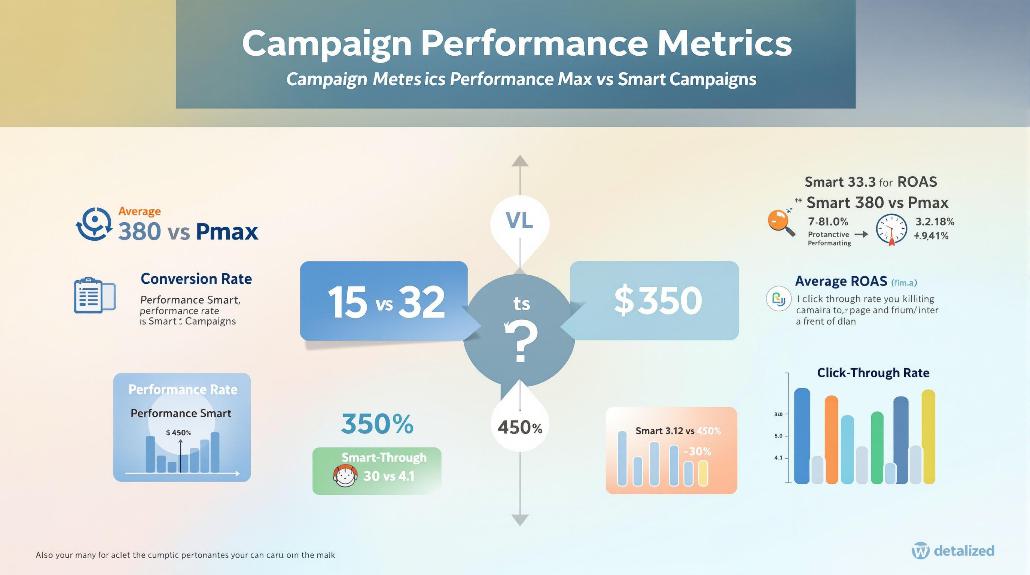
Advertisers looking to measure success will find distinct differences in how metrics are tracked and reported across these campaign types. Performance Max delivers more extensive insights into your campaign performance metrics, offering real-time data analysis and detailed reporting capabilities that weren’t available in Smart campaigns.
You’ll get access to advanced performance indicators across multiple platforms, helping you make more informed decisions about your advertising strategy.
- Real-time performance tracking across all Google platforms including Search, Display, and YouTube
- Detailed conversion metrics with automated bidding based on target ROAS
- Advanced audience interaction data showing how users engage with your ads
- Cross-platform performance comparisons to identify top-performing channels
- Historical data retention from previous Smart Shopping campaigns
With Performance Max, you’ll benefit from machine learning algorithms that continuously optimize your campaigns based on performance data.
The platform analyzes user interactions and adjusts your targeting and bidding strategies automatically. This means you’re getting more sophisticated performance tracking while maintaining efficiency in campaign management.
You can monitor how your ads perform across different channels and make data-driven decisions to improve your overall advertising results.
Making the Transition
Making the move over to Performance Max requires understanding both the automatic and manual shift options available to you. The campaign migration process happened automatically between July and September 2022, but you can still take control by creating new Performance Max campaigns yourself.
To guarantee a smooth changeover, focus on these key areas:
- Review and expand your creative assets, including images, videos, and text
- Monitor your campaign performance closely after the switch
- Take advantage of the broader reach across Google’s entire network
You’ll find that your old Smart Shopping campaigns are marked as “Removed” after the upgrade, but don’t worry – your historical data remains accessible. While you can’t revert to Smart Shopping campaigns, Performance Max offers enhanced capabilities that make the changeover worthwhile.
Remember to:
- Add diverse media formats to maximize your reach
- Leverage the AI-powered optimization features
- Use the advanced targeting options for better audience segmentation
The shift to Performance Max streamlines your campaign management while providing more sophisticated tools for optimization. You’ll spend less time on manual adjustments and more time focusing on your overall marketing strategy.
Frequently Asked Questions
Can I Revert Back to Smart Shopping Campaigns After Upgrading to Performance Max?
You can’t revert back to Smart Shopping campaigns once you’ve upgraded to Performance Max. The upgrade is permanent, and Google doesn’t provide any option to downgrade your campaigns.
How Long Does It Take for Performance Max Campaigns to Optimize Fully?
You’ll need to allow 4-6 weeks for your Performance Max campaigns to optimize fully, with consistent budget and minimal changes during this period to maximize machine learning effectiveness.
Do Seasonal Businesses Need Different Performance Max Campaign Strategies?
You’ll need distinct Performance Max strategies for seasonal businesses, adjusting budgets, assets, and audience signals to match peak periods while using historical data to anticipate and optimize for seasonal trends.
What Happens to Product-Specific Bidding When Transitioning to Performance Max?
You’ll lose direct control over product-specific bidding as Performance Max takes over with AI-driven automation, optimizing bids across all channels to achieve your overall campaign goals and ROI targets.
Can Performance Max Campaigns Work Effectively With Limited Historical Data?
You can run Performance Max with limited data, but you’ll need to provide quality assets and rely on Google’s broad audience signals while the system learns and optimizes performance.
Kyle Sweezey