2 Low Budget Google Ads Hacks for Affiliate Marketing
Let’s talk about “Low Budget Google Ads for Affiliate MarketingAffiliate marketing is a performance-based online marketing strategy where businesses (often called merchants or advertisers) reward individual marketers (known as affiliates or publishers) for driving traffic, leads, or sales to the business’s products or services. In this model, affiliates earn a commission for each agreed-upon action completed by a referred customer. Key aspects of affiliate […]”. We’re talking about making your dollars go further, in a way that still lets you tap into the goldmine of affiliate marketing without wasting money. So, grab a coffee because I want to unload some real-world examples to get us moving from budget-conscious to profit-producing affiliates on Google Ads.
In this post I will refer you to 2 videos I have done with different methods for Google Ads on a low budget. One method focuses on high intent, and the other focuses on a more problem-oriented approach and funnel. Both strategies are designed to help you maximize your ad spend while driving meaningful results, even if you’re working with limited resources. These actionable Google Ads tips 2024 will provide you with clear steps to optimize your campaigns and reach your target audience effectively. By tailoring your approach to your specific goals, you can boost conversions and get the most out of your advertising efforts.
Google Ads Budget Does NOT Define Your Success
First off, it’s important to understand that a smaller budget doesn’t mean you can’t succeed. It simply means you must play the game smarter (and longer). I’ve been down this road, spending nearly $7 million on Google Ads over 5 years. And I’ve learned a thing or two about maximizing returns, regardless of the size of your wallet.
Step #1: Picking the Right CPA Offers
Choosing the right CPA offers is super important. You want offers that pay enough so that you’re still making a good ROIReturn on Investment, a key performance indicator calculated as a percentage by dividing profit by cost and multiplying by 100. after you’ve paid for your ads.
Think about offers that pay somewhere between $75 and $150. This range is pretty solid because it allows you to play around with your ad spend but still leaves you with a nice profitTotal affiliate earnings, calculated by subtracting total cost from total revenue generated. margin.
You must also consider how well these offers will do on Google Ads. Some products just work better with search engines. It’s about matching what you’re promoting with what people are searching for and ensuring the intent is there.
If the offer fits well with the kind of searches people are doing, you’re more likely to see clicks turning into cash.
So, when you’re sifting through offers, keep in mind not just how much you’ll earn but also how likely it is that someone searching on Google will want what you’re promoting. That’s how you’ll find offers that are not just profitable but also a good fit for the platform.
Step #2: Low Budgets on Google Ads Require Precise Keyword Research
When you’re using Google Ads, the keywords you choose are pretty much everything. Your mission is to find keywords that don’t just get a lot of searches but are used by people ready to take action (like making a purchase or solving a specific problem) and yet don’t cost you too much for each click.
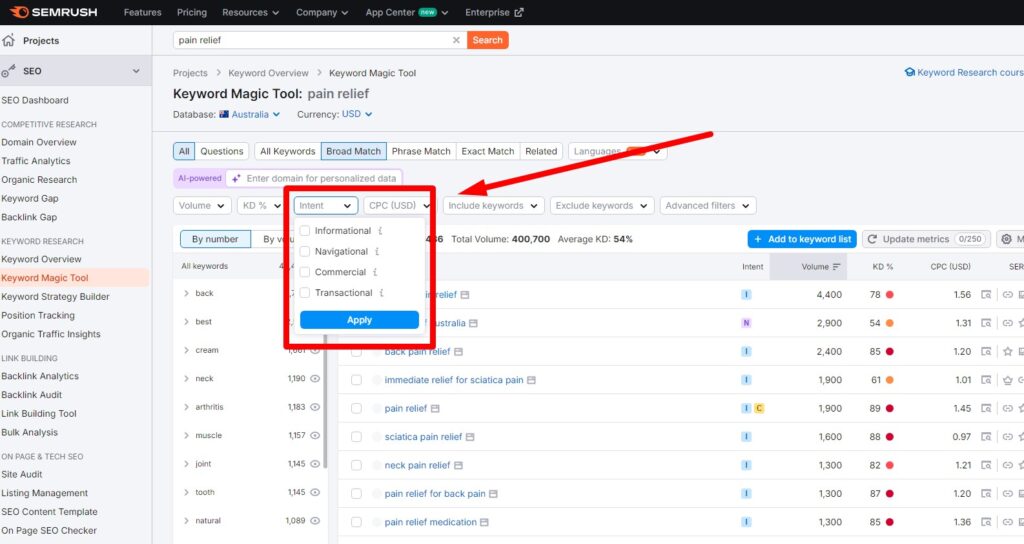
I use Semrush for this because they allow me to filter keywords by the users intent!
Another great tool is Google’s KeywordThis is the term or phrase that users utilize to search for anything on the internet. This can also be the term focused on by SEO experts to drive organic traffic to their website. Planner. These tools are essential because they let you dig deep to find what potential customers are searching for. You’re not just shooting in the dark; you’re using these tools to pinpoint the exact phrases with a good balance of search volume and competition level.
Ideally, you want specific keywords—those that show someone is not just browsing but looking to buy something soon.
With a low budget for your Google search ads, finding those low-cost but high-intent keywords is crucial. Using a high intent focussed strategy you’re looking for terms that indicate someone is in the later stages of the buying process.
Phrases that include words like “buy,” “deal,” “discount,” or specific product names tend to be great because they show that someone is past the research phase and ready to pull out their wallet. But you also have to consider that, in many cases, these keywords could be more expensive.
In essence, you’re being very deliberate with your keyword selection, using these tools to filter out the noise and hone in on those terms that are most likely to convert searchers into buyers without skyrocketing your ad spend. It’s all about balancing cost with the potential for conversionThe completion of a desired action by a user# such as a purchase# sign-up# or download. Conversions are the ultimate goal of most marketing campaigns and serve as a key metric for measuring success..
Step #3: Congruent Landing Pages
Your landing page is where the magic happens. It’s not just about catching the user’s eye; it’s about holding their hand and guiding them through to a conversion. This means creating a page that resonates with the ad they clicked and speaks directly to their needs and desires.
A well-crafted landing page uses the problem-agitate-solution formula, identifying the visitorThis is a user who landed on your page.’s pain point, agitating that problem, and then offering your affiliate product as the solution.
Step #4: Bid Wisely
When working with a limited budget on Google Search Ads, every cent you bid needs to work hard for you. Start with enhanced CPC (Cost Per Click) to dip your toes in the water and gauge the effectiveness of your keywords and ads. Consider using negative keywords to eliminate irrelevant clicks and conserve your budget. Additionally, consider leveraging brand bidding for affiliate marketing to capitalize on existing brand recognition and drive trafficThis is the inflow of visitors to a page. to your site. By strategically bidding on branded keywords related to the products or services you offer, you can potentially increase your click-through rate and maximize your return on investment.
Make sure you have proper conversion trackingThe process of measuring and analyzing how many visitors to a website complete a desired action, such as making a purchase or signing up for a newsletter. in place. I use CPV Lab Pro for this since they integrate easily and post all my conversions to Google.
As you see which keywords convert, consider moving to a target CPA (Cost-per-acquisition) bidding strategy, allowing Google’s algorithms to find the best opportunities for your ads.
If you want more strategies and tips on how to bid like a master, check out our Google Ads Challenge.
Step #5: Testing and Optimization
Getting your Google Ads campaign up and running is just the beginning. The key to making your campaign profitable is constantly testing and optimizing every part of it. This is where you start to see what’s working and what’s not.
For your ads, it might mean playing around with the wording or the images you use, or the extensions. Sometimes, just changing a few words in your ad copy can make a big difference in how many people click on it. It’s all about finding what resonates with your audience.
Your landing page is another area where small changes can have big impacts. Maybe the layout needs tweaking, or adding a video or changing the call-to-action button color could increase conversions. The goal is to ensure that once people land on your page, they’re more likely to take the action you want.
Then there are the keywords and offers. Maybe some keywords aren’t bringing in the right kind of traffic, or perhaps a different offer might convert better. It could also be worth looking into who you’re targeting. Maybe your ads and offers would do better with a slightly different audience demographic.
The bottom line is, don’t just set your campaign and forget it. Dive into the data, see what it’s telling you, and don’t be afraid to experiment. The most successful campaigns are those that are constantly refined and optimized over time.
Real-World Examples: Case Studies
If you’re looking for examples of Google Ads campaigns that actually work, we’ve got plenty of strategies. Inside our affiliate forum and training sessions, we break down these campaigns so you can see what strategies were used and how they turned out. It’s like getting a behind-the-scenes look at what makes a successful campaign tick.
You’ll see more examples, get insights on tweaking your campaigns, and learn from others’ wins and mistakes. It’s all about getting better results without having to go through all the trial and error yourself.
A Problem-Focussed Strategy
I recently did another video that talks more about a low-budget Google ads strategy that uses a “problem-focussed” strategy where you try to solve someone’s problems by offering them something for free. You can watch the video here:
Scaling Your Success
Once you’ve found a winning formula, it’s time to think about scaling. But here’s where you need to tread carefully. Scaling doesn’t mean just increasing your budget. It means gradually expanding your keyword list, experimenting with similar offers, and maybe even venturing into new countries with similar demographics.
Conclusion: Making the Most of Small Budgets for Google Ads
Ending on a strong note, diving into Google Ads doesn’t require a big budget. With the right approach, even low budgets can see impressive results. It boils down to strategic planning, selecting offers that align with your budget and niche, and optimizing every facet of your campaign, from keywords to landing pages. Remember, success in Google Ads isn’t about how much you spend, but how wisely you use what you have. By focusing on high-intent keywords, refining your ad copy, and continually testing and tweaking, you can create a campaign that not only performs well but also maximizes your return on investment.

Joey Babineau
Founder, Powerhouse Affiliate
Joey Babineau has spent over 20 years as a full-time affiliate marketer and paid-media buyer, personally running and scaling campaigns across Google Ads, native, push, and social traffic. He founded Powerhouse Affiliate to teach the exact strategies behind his own real campaigns, breaking down live spend, ROI, and the offers that actually convert.