Do you need an affiliate marketing website to make money?
Short answer: it depends on your strategy, not on whether someone told you that you need one. Most "you need an affiliate marketing website" advice is wrong because it skips the diagnostic step. Let's do the diagnostic instead.

Why most affiliates fail without one (and why some succeed anyway)
The honest version: most affiliates fail because they have nowhere durable to send the trafficThis is the inflow of visitors to a page. they generate. They run ads, post on social, build a small audience, and every time they stop pushing, the income stops too. Nothing compounds.
A website is the durable surface. Articles that rank keep ranking. Email lists keep emailing. Landing pages keep converting. You build once, traffic keeps showing up, conversions keep happening.
But here is the part most "build a website" advice misses: the kind of site you need is wildly different depending on your strategy. A content-and-SEO affiliate and a paid-traffic media buyer both need a website, and the SAME site setup will fail BOTH of them. WordPress is the right tool for the first one and the wrong tool for the second one. A static landing page is the right tool for the second one and the wrong tool for the first one.
So the real question is not "do I need a website?" The real question is "which kind?"
Pick the job, then pick the tool
Find the row that describes how you plan to drive trafficThis is the inflow of visitors to a page. and make money. That row points you at the right kind of affiliate marketing website for your situation.
Rank on Google with content
WordPressLooks like: Review sites, "best X for Y" comparisons, how-to articles, niche authority blogs.
Site shape: 50 to 500+ pages over time
- SEO authority compounds with every published page
- Plugins for SEO, schema markup, content optimization
- Bloat and load time are an OK trade because Google indexes words, not JavaScript
Convert traffic into sales
AI + Cloudflare staticLooks like: Paid traffic funnels, single-offer landing pages, retargeting campaigns.
Site shape: 1 to 5 pages, blazing fast
- Sub-second load times matter, every 100ms costs conversions
- No plugins to break, no hosting bills, no maintenance tail
- AI builds the copy and structure in an afternoon, you tweak and ship
Run YouTube or social as your primary engine
AI + Cloudflare staticLooks like: Channel descriptions point at one landing page, you batch content elsewhere.
Site shape: One or two static pages, occasional refreshes
- Your audience lives on the platform, the site is just the conversion endpoint
- No SEO concern, so optimize purely for opt-ins and clicks
- Static pages match the audience pace, you change the page when you change the campaign
Build the business on an email list
WordPressLooks like: Lead magnet to opt-in to autoresponder. The list IS the asset.
Site shape: Opt-in page plus a thank-you page, sometimes a small blog
- OptimizePress makes templated opt-in pages a 30-minute job, no design skills needed
- Easy A/B testing and split-testing built into the OptimizePress builder
- Native integration with AWeber for the autoresponder side
Most serious affiliates eventually run both kinds of website
Here is what the established affiliates you are trying to copy actually do: they run WordPress on a subdomainThis is a domain that is just a section of a primary domain. This can be used to create a complementary website, a redirect link, a landing page, or more. like blog.theirdomain.com for SEO content that compounds for years, AND they run fast static landing pages at the root domain for paid traffic and lead capture. Different jobs, different tools, both at the same time.
Powerhouse Affiliate itself runs exactly this pattern. The main site is a fast Next.js front end on Cloudflare. The blog runs separately on the WordPress side. They serve different jobs and the visitorThis is a user who landed on your page. never knows the difference.
You do not have to start with both. Start with whichever path matches your immediate strategy and add the other when it actually pays for itself. The mistake is forcing one tool to do both jobs and then wondering why the site feels wrong.
Four mistakes that cost real money
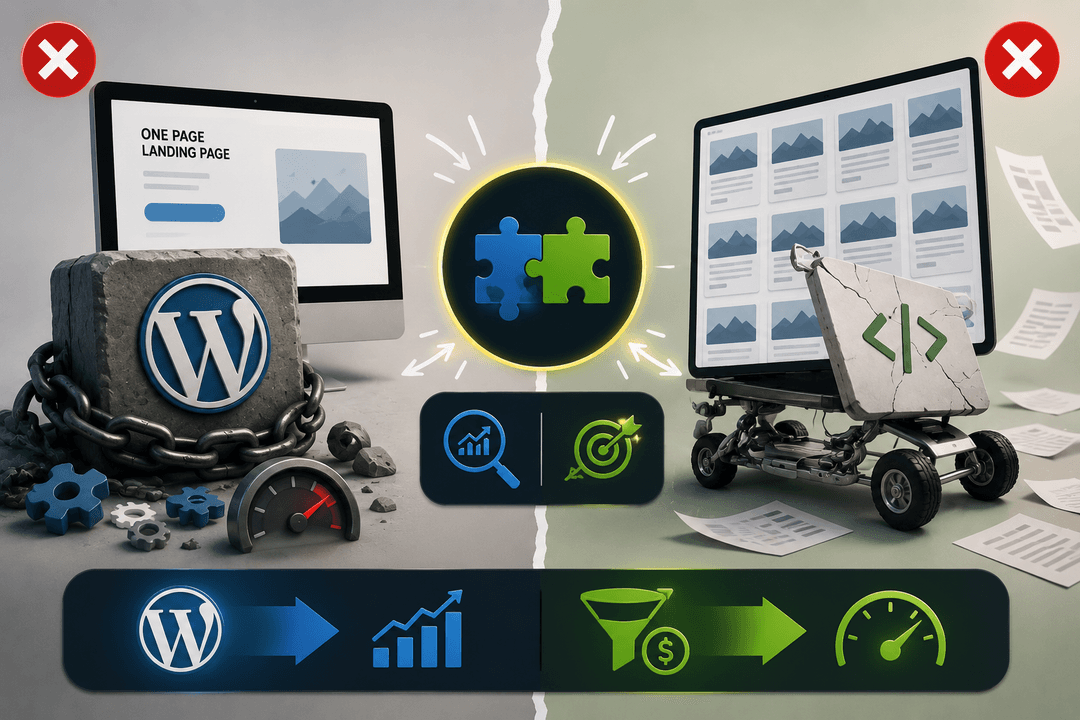
Buying premium WordPress hosting plus a $79 theme for a single landing page
Static page on free Cloudflare Pages would have launched in two hours and loaded twice as fast.
Trying to run a 200-article review site on a static site generator with no CMS
WordPress is the right tool for a content-heavy SEO play. Pick the right tool for the job.
Treating "build the website" as the project instead of "decide who I am writing to"
Site comes AFTER avatar work and niche selection. Build the strategy first, the tech is a one-day job once the strategy is right.
Picking WordPress because "everyone uses it"
Everyone uses WordPress because most use cases that built the popularity (blogs) need a CMS. Funnels do not.
Now, the actual affiliate marketing website setup
Pick the path that matches the job you picked above. Each one is a step-by-step build guide with real costs, real tradeoffs, and the exact stack to use.
Part 2: The WordPress path
Best for: content + SEO affiliates and email-list builders.
- Namecheap domain, Bluehost hosting, OptimizePress for opt-in pages, AWeber for email
- Real monthly cost: $10 to $30
- Time to first published article: one weekend
Part 3: The AI + Cloudflare path
Best for: funnel and paid-traffic affiliates who need speed and zero maintenance.
- Domain, free Cloudflare Pages, AI-generated copy, deploy in an afternoon
- Real monthly cost: $1 (just the domain renewal averaged)
- Time to live URL: one afternoon
Skip the trial and error.
Powerhouse Affiliate members get AI tools that handle the parts most affiliates get stuck on: picking the right niche, writing the funnel copy, and getting it deployed. Both site paths get faster when the strategy is already done.